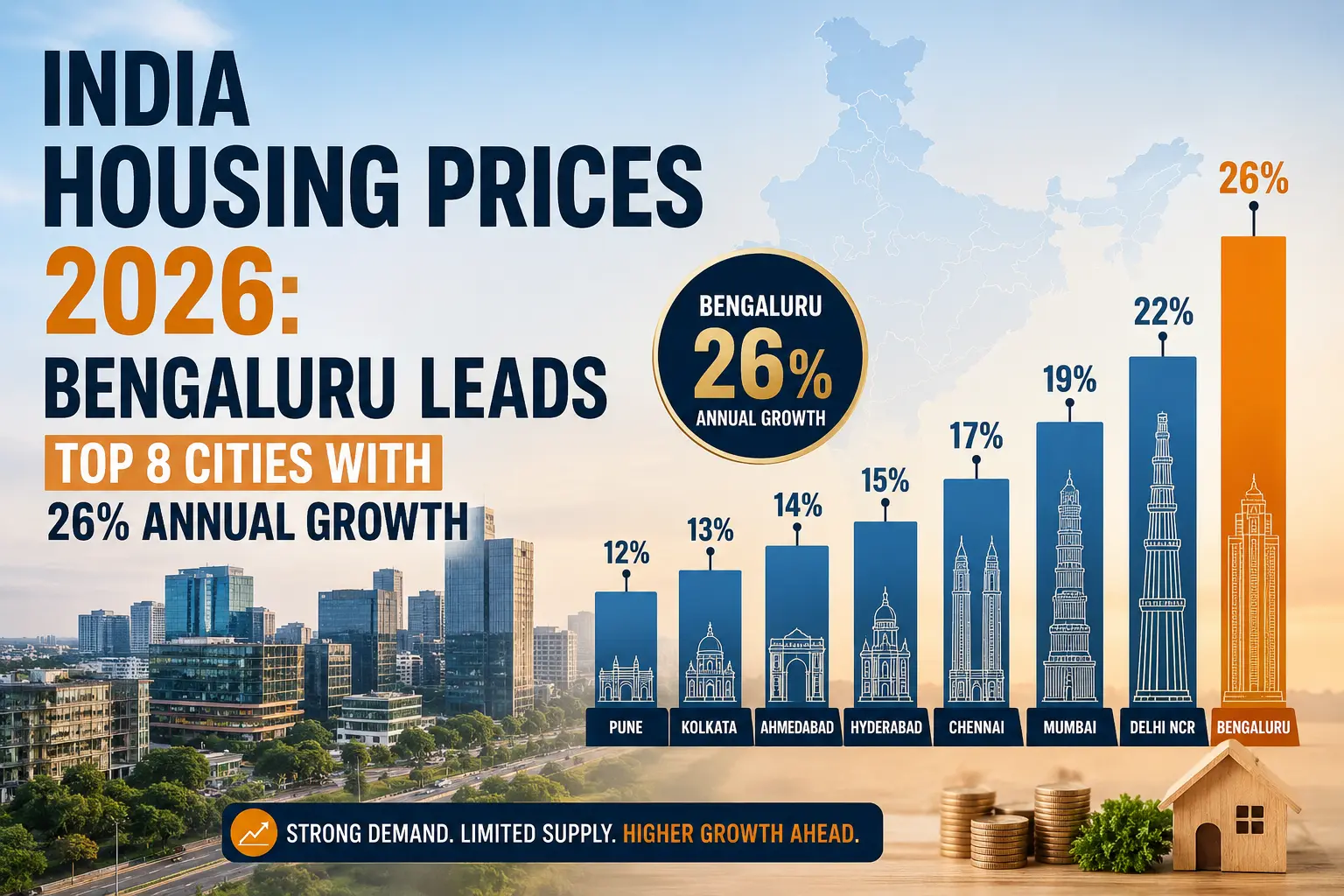
India Housing Prices 2026: Bengaluru Leads Top 8 Cities With 26% Annual Growth
Quick answer: India housing prices 2026 rose year-on-year in all eight major property markets during Q2 (April–June). Bengaluru recorded the steepest jump at 26% (average ₹9,931/sq ft), followed by MMR at 20.4% (₹15,422/sq ft) and Pune at 13.7%, which crossed ₹8,000/sq ft for the first time. Overall home sales across the eight cities fell 6.1% YoY to 91,729 units, even as prices climbed — a sign the market is tilting toward affordability pressure rather than a supply glut.
Key Takeaways
- India housing prices 2026 rose in every one of the top 8 cities tracked this quarter — no market recorded a decline.
- Bengaluru is India’s fastest-appreciating housing market: +26% YoY, average price ₹9,931/sq ft, despite a 9.2% sales dip.
- Pune crossed the ₹8,000/sq ft mark for the first time, up 13.7% YoY, even as sales fell 20.8%.
- MMR (Mumbai Metropolitan Region) stayed the largest market by both sales volume (24,112 units) and price (₹15,422/sq ft), up 20.4% YoY.
- Ahmedabad remains the most affordable of the eight cities at ₹5,295/sq ft, but posted the strongest quarter-on-quarter rise (+7%).
- Chennai had the smallest annual price rise (4.4%) but the biggest jump in sales volume (+36% YoY).
- Across all 8 cities: 91,729 homes sold vs 89,161 new units launched in Q2 2026 — sales down 4.4% QoQ and 6.1% YoY.
- A stable RBI repo rate of 5.25% and easing inflation have kept borrowing costs predictable, cushioning the affordability squeeze.
- The data behind this India housing prices 2026 report comes from News Sources, covering Ahmedabad, Bengaluru, Chennai, Delhi-NCR, Hyderabad, Kolkata, MMR, and Pune.
India Housing Prices 2026: City-Wise Snapshot
Bengaluru led all eight cities in annual price growth, with average rates climbing 26% year-on-year to ₹9,931 per square foot. That appreciation came even as sales slipped to 14,186 units from 15,628 units a year earlier — a decline of 9.2%. Developers, however, appear undeterred: new launches in the city rose 36.7% annually to 16,827 units, pointing to continued confidence in long-term demand.
The Mumbai Metropolitan Region (MMR) remained the country’s largest and most expensive market. It recorded 24,112 housing sales in Q2 2026 at an average price of ₹15,422 per square foot, up 20.4% year-on-year. Sales volume, though, was down 7% from the same quarter last year, echoing the broader trend within India housing prices 2026 of rising rates alongside softening transactions.
Pune posted a milestone quarter, with average prices reaching ₹8,084 per square foot — a 13.7% annual increase and the first time the city has crossed the ₹8,000 per square foot mark. Sales in Pune fell sharply, down 20.8% year-on-year, reinforcing that even strong price momentum isn’t translating into higher transaction volumes.
Ahmedabad stayed the most affordable market among the top 8, with average prices at ₹5,295 per square foot. It also recorded the strongest sequential (quarter-on-quarter) price increase of the group, at 7%, suggesting the city’s affordability edge may be narrowing faster than its year-on-year numbers suggest.
Chennai stood out for the opposite reason: it had the smallest annual price increase among the eight cities, at 4.4%, but the strongest sales performance, with a 36% year-on-year rise in transactions — even as new launches fell 43.3% annually.
Delhi-NCR, Hyderabad, and Kolkata also recorded year-on-year price increases in this report, though granular per-square-foot figures for these three markets weren’t broken out in the coverage reviewed for this guide.
Why Are India Housing Prices 2026 Rising Across the Top Cities?
A few forces are behind this year’s India housing prices 2026 trend, and they’re showing up consistently across cities:
- Disciplined supply. New launches (89,161 units) stayed close to sales volume (91,729 units) across the eight cities, which has kept unsold inventory from piling up and supported price stability.
- Developer confidence in select markets. Bengaluru saw new launches jump 36.7% YoY even as sales dipped — developers are betting on long-term demand rather than pulling back.
- Stable interest-rate environment. The RBI has held the repo rate at 5.25%, and inflation has been moderating, giving buyers and lenders a predictable cost backdrop.
- A shift toward premiumisation. Builders are increasingly targeting higher-value segments, which pushes up average price per square foot even when unit sales volumes soften.
Why Are Home Sales Falling Even as Prices Rise?
This is the paradox buyers are grappling with in India housing prices 2026 data: prices are up in every single one of the top 8 cities, but transaction volumes are down 6.1% YoY overall. The likely explanation is affordability fatigue — annual price appreciation now ranges from 4.4% (Chennai) to 26% (Bengaluru), which is outpacing income growth for many prospective buyers and pushing some purchase decisions to the sidelines, particularly in high-appreciation markets like Bengaluru and Pune where sales fell despite (or because of) sharp price gains.
What Should Home Buyers Do in 2026?
Given how India housing prices 2026 have moved so far, buyer strategy really depends on the city:
- In Bengaluru and Pune: Expect to pay a premium; if you can afford it, locking in now may still beat waiting given the pace of appreciation — but budget carefully, as affordability is visibly stretched.
- In Ahmedabad: Still the most accessible of the top 8 markets on price, but the fastest quarter-on-quarter rise (+7%) suggests the affordability window may be narrowing.
- In Chennai: The slowest price growth (4.4% YoY) combined with strong sales momentum (+36% YoY) could make it a relatively balanced market for value-conscious buyers.
- Everywhere: A steady repo rate of 5.25% means EMI planning is more predictable right now than it has been in recent volatile cycles — a good time to get loan pre-approval and compare lenders.
What Should Investors Watch Next Quarter?
The report flags the upcoming festive quarter (Q3 2026) as the real test for India housing prices 2026 trends — it will show whether developers and buyers can sustain current price momentum without further denting sales volumes. Watch for:
- Whether festive-season launches trigger fresh sales momentum or simply add to a market already showing YoY sales declines.
- Whether cities with the steepest price growth (Bengaluru, MMR, Pune) see any cooling as affordability becomes a bigger talking point.
- RBI policy signals — any change to the 5.25% repo rate would directly affect buyer sentiment and EMI affordability.
Frequently Asked Questions on India Housing Prices 2026
Which city recorded the highest housing price growth in 2026? Bengaluru, with a 26% year-on-year increase, taking its average price to ₹9,931 per square foot — the sharpest rise among all top 8 cities tracked for India housing prices 2026.
Which is the most expensive housing market among India’s top 8 cities in 2026? The Mumbai Metropolitan Region (MMR), at an average of ₹15,422 per square foot.
Which city has the most affordable housing among the top 8 markets? Ahmedabad, at an average of ₹5,295 per square foot — even though it posted the sharpest quarter-on-quarter price rise (+7%) of the group.
Did home sales rise or fall in 2026? Sales fell. Across the eight major cities, 91,729 homes were sold in Q2 2026, down 4.4% quarter-on-quarter and 6.1% year-on-year, even as India housing prices 2026 rose in every city.
Has Pune crossed the ₹8,000 per square foot mark? Yes, for the first time. Pune’s average price reached ₹8,084 per square foot in Q2 2026, up 13.7% year-on-year.
What is driving the price rise despite falling sales? Disciplined new launches (89,161 units, close to the 91,729 units sold) have kept unsold inventory in check, while developers continue targeting premium segments — supporting prices even as transaction volumes soften.
What is the current RBI repo rate, and how does it affect home buyers? The RBI repo rate stood at 5.25% as of this report, with moderating inflation. A stable rate gives buyers more predictable EMI costs, which is one factor cushioning demand even as prices climb.
Are India housing prices 2026 expected to keep rising? The report points to the festive Q3 2026 quarter as the key test. If new launches and buyer demand stay balanced the way they did in Q2, price growth is likely to continue, though possibly at a more moderate pace in cities where affordability is already stretched.
Which city had the smallest price increase among the top 8? Chennai, with a 4.4% year-on-year rise — the lowest of the eight cities — though it posted the largest jump in sales volume, up 36% YoY.
Conclusion
India housing prices 2026 tell a clear story: every one of the top 8 property markets is appreciating, led decisively by Bengaluru’s 26% surge, while overall sales volumes are cooling under the weight of affordability pressure. Whether this trend holds through the festive Q3 2026 quarter will depend on how buyers, developers, and the RBI’s interest-rate stance interact in the months ahead.
This guide is for informational purposes and does not constitute investment or financial advice. Property prices vary by micro-market, project, and configuration — always verify current rates with a local broker or developer before making a purchase decision.