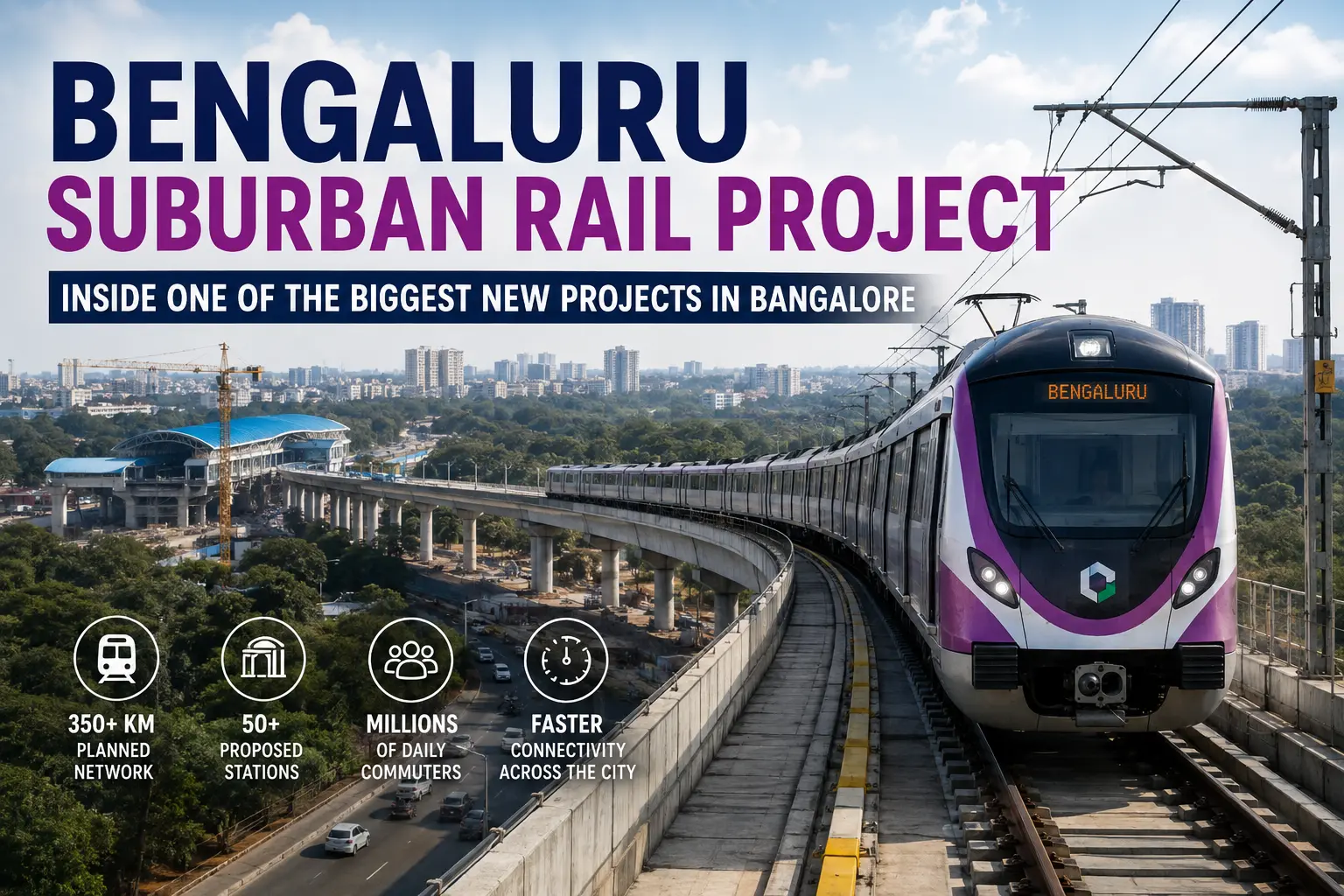
Bengaluru Suburban Rail Project: Inside One of the Biggest New Projects in Bangalore
If you are following new projects in Bangalore that will genuinely change how the city moves, the Bengaluru Suburban Rail Project deserves to be at the top of your list. Officially known as BSRP and implemented by K-RIDE (Karnataka Rail Infrastructure Development Enterprises Ltd.), this 148.17 km rail network is being built across four corridors that will eventually connect Bengaluru’s outer belts — Chikkabanavara, Rajanukunte, Devanahalli, and Whitefield — to the heart of the city through KSR Bengaluru and Baiyyappanahalli.
It is one of the most ambitious pieces of transit infrastructure the city has attempted, and like most large-scale new projects in Bangalore, it comes with both exciting long-term promise and a timeline that has already shifted.
As of the latest official update, the project is 19.95 percent physically complete, which means roughly 80 percent of the work is still remaining. Construction began back in 2022, so nearly four years in, less than a fifth of the network is actually built. The original deadline set by the Centre was October 2026, but that date has now been revised to March 2030, a slippage of about 41 months.
For anyone tracking new projects in Bangalore for commuting, investment, or real estate purposes, this pushed-back timeline is important context — the suburban rail is very much a medium-to-long-term addition to the city’s transport map rather than something arriving in the next year or two.
Why the Bengaluru Suburban Rail Project Matters
Bengaluru’s road network and Metro system are already stretched thin, and the suburban rail is meant to work alongside them rather than replace them. Think of it as a commuter rail system in the mold of Mumbai’s suburban trains — a way to move large numbers of people quickly between the outskirts and the city center without adding more cars to already congested roads. Once operational, it will give residents of areas like Whitefield, Rajanukunte, and Chikkabanavara a dedicated rail option that simply does not exist today.
It will also, crucially, extend rail connectivity all the way to Kempegowda International Airport, something that has long been on the wish list for both daily commuters and frequent flyers in the city.
This is exactly the kind of infrastructure development that tends to reshape property demand along its route, which is why the Bengaluru Suburban Rail Project keeps coming up whenever people search for new or upcoming projects in Bangalore that could influence where to live, rent, or invest over the next few years.
The Four Corridors of the Suburban Rail Network
The BSRP is not a single line but a network of four corridors, each carrying a distinct name inspired by Karnataka’s state flower themes, and each at a different stage of progress.
The Mallige line, designated C-2, runs 25.01 km from Baiyyappanahalli to Chikkabanavara. This is the priority corridor of the entire project, with civil works and tenders progressing at a faster pace than the others. Its revised target date is December 2028, making it the segment most likely to open first and give the public an early look at what the suburban rail experience will actually be like.
The Kanaka line, or C-4, is the longest of the four at 46.24 km, connecting Heelalige to Rajanukunte. Land acquisition for this corridor has already been completed, and station construction work is currently underway. Its revised target is June 2029, placing it second in line after the Mallige corridor.
The Sampige line, C-1, stretches 41.40 km from KSR Bengaluru to Devanahalli, terminating near the airport. This is the corridor that will eventually deliver direct rail access to Kempegowda International Airport, which makes it one of the most anticipated segments of the whole project. The alignment for this line has been cleared, but a substantial amount of execution work still lies ahead, and its revised target is set for March 2030.
Finally, the Parijaata line, C-3, covers 35.52 km between Kengeri and Whitefield. This is considered a later-stage corridor within the project, with land acquisition, procurement, and execution still largely pending. Like the Sampige line, its revised target is March 2030.
Together, these four corridors add up to the full 148.17 km network. Importantly, K-RIDE has indicated that the corridors will not all open on the same day. Instead, they are expected to become operational in phases as each one nears completion, starting with the Mallige line.
That phased rollout approach is common with large infrastructure projects and means residents along the earlier corridors could realistically see benefits well before the entire network is finished in 2030.
The Numbers Behind the Project
Beyond the corridor-level details, a few figures help put the scale of the Bengaluru Suburban Rail Project in perspective. The plan includes 306 coaches to run across the network once complete, at an estimated cost of around ₹4,300 crore for the train sets alone. Of that amount, Karnataka’s share works out to ₹2,135 crore, with the rest funded through central and other contributions typical of joint rail infrastructure ventures.
These are significant investments, underscoring that this is not a minor add-on to the city’s transit system but a full-scale rail network being built from the ground up.
It is worth pausing on the progress figures again, because they tell an honest story. Nineteen point nine five percent completion after roughly four years of construction is a reminder that urban infrastructure of this scale in India typically takes longer than initial estimates suggest.
Land acquisition, utility shifting, contractor mobilization, and civil engineering across nearly 150 km of alignment are inherently complex, and the almost three-and-a-half-year slippage from the original October 2026 date reflects that complexity rather than any single point of failure.
What This Means If You’re Tracking New Projects in Bangalore
For homebuyers, renters, and investors who follow new projects in Bangalore closely, the suburban rail project offers a useful long-range signal rather than an immediate trigger. Areas near the Mallige corridor stations are the ones most likely to see visible construction progress and eventual service first, given the December 2028 target.
If you are specifically interested in connectivity to the airport, the Sampige line is the one to watch, though its March 2030 target means that benefit is still several years out.
For daily commuters currently relying on buses or private vehicles to reach the outer parts of the city, the suburban rail represents a genuine future alternative, but patience will be required. The project’s revised timeline suggests that meaningful, city-wide impact from the Bengaluru Suburban Rail Project is unlikely before the very end of this decade, with partial benefits arriving earlier along the Mallige and Kanaka corridors.
Final Take
Among the many new projects in Bangalore currently under construction, the Bengaluru Suburban Rail Project stands out simply because of its scale and its potential to genuinely change commuting patterns across the city. A 148 km, four-corridor rail network connecting the outskirts to the city core and the airport is not a small undertaking, and the fact that it is being delivered in phases, starting with the Mallige line, gives residents something concrete to watch for over the next few years.
The revised March 2030 deadline is a more realistic marker than the original 2026 target, and as construction continues, progress updates on land acquisition, station works, and corridor-wise completion will remain one of the most closely watched infrastructure stories in the city.
Frequently Asked Questions
What is the Bengaluru Suburban Rail Project?
It is a 148.17 km commuter rail network being built across four corridors in Bengaluru by K-RIDE, designed to connect the city’s outer areas to the core and to Kempegowda International Airport.
How much of the Bengaluru Suburban Rail Project is complete?
As of the latest update, physical progress stands at 19.95 percent, with about 80 percent of the work still remaining.
When will the Bengaluru Suburban Rail Project be finished?
The revised completion target is March 2030, delayed from the original October 2026 deadline by roughly 41 months.
Which corridor of the suburban rail will open first?
The Mallige line (Baiyyappanahalli to Chikkabanavara) is the priority corridor and has the earliest revised target of December 2028.
Will the suburban rail connect to Bengaluru airport?
Yes, the Sampige line running from KSR Bengaluru to Devanahalli will provide direct rail access to Kempegowda International Airport, targeted for March 2030.
Who is building this project?
K-RIDE, or Karnataka Rail Infrastructure Development Enterprises Ltd., is implementing the Bengaluru Suburban Rail Project.
This overview reflects the most recent publicly available K-RIDE progress figures. For live updates on this and other new projects in Bangalore, check official K-RIDE communications, since construction timelines are subject to change.